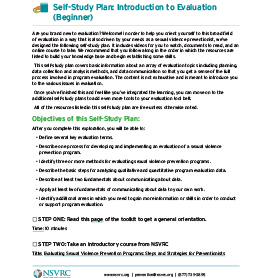
This worksheet provides questions to reflect on the Self-Study Plan: Introductions to Evaluation, and is part of the Evaluation Toolkit. Publish Date June 2018
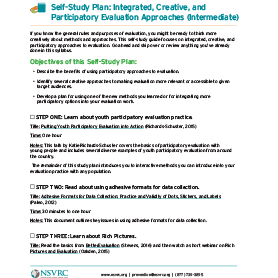
This worksheet provides questions to reflect on the Self-Study plan on Integrated, Creative, and Participatory Evaluation Approaches, and is part of the Evaluation Toolkit. Publish Date June 2018
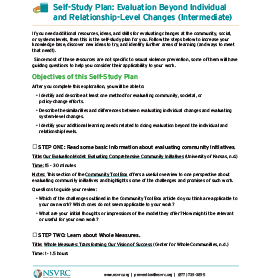
This worksheet provides questions to reflect on the Self-Study plan on evaluation beyond individual and relationship level changes, and is part of the Evaluation Toolkit. Publish Date June 2018
This self-study plan covers basic information about an array of evaluation topics including planning, data collection and analysis methods, and data communication so that you get a sense of the full process involved in program evaluation, and is part of the Evaluation Toolkit. It includes videos for you to watch, documents to read, and an...
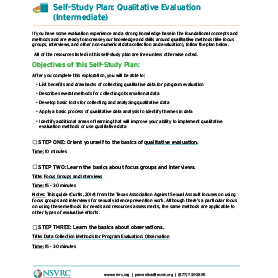
This self-study guide, which is a part of the Evaluation Toolkit, focuses on increasing knowledge and skills around qualitative methods (focus groups, interviews, and other non-numerical data collection and evaluation). It includes up to 5 hours of online training options, as well as, in-person training opportunities. Using this plan will help learners understand the benefits...
This self-study guide, which is a part of the Evaluation Toolkit, focuses on integrated, creative, and participatory approaches to evaluation. It includes up to 6 hours of online training options, as well as, in-person training opportunities. This intermediate level plan will assist learners in describing the benefits of using participatory approaches to evaluation, identifying creative...
This self-study guide, which is part of the Evaluation Toolkit, includes up to 5 hours of online training options, as well as, in-person training opportunities to help learners identify and describe methods for evaluating community, societal and policy-change efforts and the similarities and differences between evaluating individual changes and system-level changes. Publish Date June...
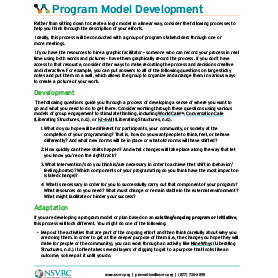
This guide is designed to help program stakeholders develop a sense of where they want to go and what they need to get there through interactive activities that help describe program model(s), and is a part of the Evaluation Toolkit. Publish Date June 2018
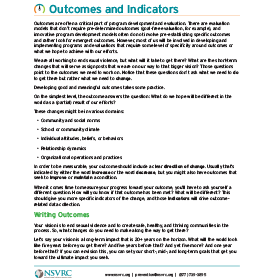
This guide, which is a part of the Evaluation Toolkit, defines outcomes and indicators and leads the reader through a visioning process to develop SMART (Specific, Measurable, Achievable, Realistic, Time-Bound) outcome statements. Publish Date June 2018
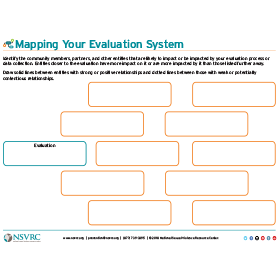
This worksheet provides a visual mapping tool to identify community members, partners and other entities that might impact or be impacted by an evaluation process, and is part of the Evaluation Toolkit. Publish Date June 2018
Nulla vitae elit libero, a pharetra augue. Nulla vitae elit libero, a pharetra augue. Nulla vitae elit libero, a pharetra augue. Donec sed odio dui. Etiam porta sem malesuada.