Search Results

node
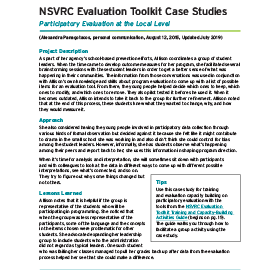
Participatory Evaluation at the Local Level
This case example provides a description of participatory evaluation within a school-based prevention program were staff worked with student leaders to develop outcome measures, provide observations, and analyze and interpret the data collected. Read more case examples through the NSVRC Evaluation Toolkit.  Publish Date September 2019
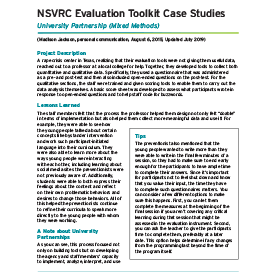
University Partnership
This case example provides a description of a partnership between a rape crisis center and a university to create a meaningful pre/post-test questionnaire to evaluate their prevention program. Read more case examples through the NSVRC Evaluation Toolkit. Publish Date September 2019
SADI
Advocates can enhance the care that they provide for survivors with these tools.
Section 6: Victim-Centered Approaches
System-Based Communities Campus Sexual Assault The focus on campus sexual assault in recent years stems from the work of student activists and victims who have spoken out about the issue, attracting media attention and prompting federal and state legislation and guidance for more effective efforts at prevention and response. As a result, SARTs have become...
Section 6: Victim-Centered Approaches
Cultural and Ethnic Communities SARTs should consider racial justice critical in addressing and ending sexual violence. Committing to racial justice propels sexual violence prevention work forward and helps to dismantle power imbalances that have long existed in the United States. SARTs should commit to using their power and privilege to ensure that the needs of...
Section 6: Victim-Centered Approaches
Cultural Responsiveness Victim-centered SART responses need to provide competent, culturally relevant, and responsive care. SARTs and member organizations can choose from a variety of trainings based in cultural competency or cultural responsiveness. The concept of “cultural competency” often includes a well-meaning but misguided notion that service providers can reach some predetermined level of expertise in...
Section 6: Victim-Centered Approaches
[1] Lindsay Hixson, Bradford Hepler, and Myoung Ouk Kim, 2012, The Native Hawaiian and Other Pacific Islander Population: 2010, Washington, DC: U.S. Census Bureau. Retrieved June 7, 2017, from LINK Elizabeth Hoeffel, Sonya Rastogi, Myoung Ouk Kim, and Hasan Shahid, 2012, The Asian Population: 2010. Retrieved June 7, 2017, from LINK Tina Norris, Paula Vines,...
Engaging New Voices
We can all use our voices to change the culture to prevent sexual violence. Prevention requires addressing the roots causes and social norms that allow sexual violence to exist. This April, we’re calling on groups whose influence can play a critical role in changing the culture. Engaging New Voices Postcards Printed versions of the postcards...

Find Help

October 10, 20170
Find Help and Support There is a national network of community-based rape crisis centers and local organizations who support the needs of sexual assault survivors. These centers exist across the United States to provide supportive services to victims of sexual assault.   Local centers have trained advocates that provide free and confidential services and can assist survivors.  If they...
Committing to racial justice propels sexual violence prevention work forward and helps to dismantle power imbalances that have long-existed in the United States. 
1 8 9 10 11