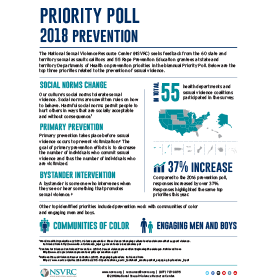
The National Sexual Violence Resource Center (NSVRC) seeks feedback from the 60 state and territory sexual assault coalitions and 55 Rape Prevention Education grantees at the state and territory departments of health on prevention priorities in a biannual Priority Poll. Publish Date July 2018
The NSVRC Evaluation Toolkit was created for prevention workers at the local and state levels to increase the capacity to implement program evaluation for sexual violence prevention work by providing tools and guidance for both program implementers and those who support them.
Colleges and universities can be great resources for agencies that need assistance with developing evaluation processes for their work. Depending on your budget and the scope of your evaluation, there are options to hire professors or graduate students for assistance. Also, it’s not unusual for students to need program evaluation internships or projects for classes....
To increase participant engagement with questionnaires, they can be administered through interactive means rather than on a piece of paper or through a computer. Interactive options have the potential to be more engaging for participants by increasing their kinesthetic involvement and feeling less like tests (Dodson & Paleo, 2011). Consider the following examples: Respond by...
What does it take to do good evaluation? When you read the question above, do you immediately think about data analysis skills? Or survey design skills? While an evaluator needs skills in data collection and analysis, these are only two of the many areas of knowledge and skill that help an evaluator succeed. An organization’s...
Comprehensive primary prevention work requires that we work beyond the individual and relationship levels in order to create deep and meaningful change in our communities. The prospect of evaluating beyond the individual and relationship levels of our work can seem daunting. However, although the potential scope of data collection is larger for community-level initiatives, the...
Once you’ve collected data, you need to turn the raw data into a form that is more useful for driving decision making. That means you need to analyze the data in some way. Qualitative and quantitative data are analyzed in different ways. Qualitative Data There are a variety of ways to analyze qualitative data, and...
Outcomes are often a critical part of program development and evaluation. There are evaluation models that don’t require pre-determined outcomes (goal-free evaluation, for example) and innovative program development models often do not involve pre-establishing specific outcomes and rather look for emergent outcomes. However, most of us will be involved in developing and implementing programs...
This collection of slides created in Microsoft PowerPoint, which is part of the Evaluation Toolkit, accompanies the Training and Capacity-Building Activities Guide in order to easily integrate the activities into training materials. Available slides are indicated in the activity instructions by slide number. Publish Date June 2018
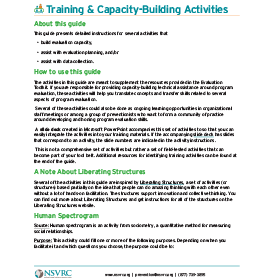
This guide presents detailed instructions for several activities that build evaluation capacity, assist with evaluation planning, and/or assist with data collection, and is part of the Evaluation Toolkit. Also, check out the corresponding downloadable slide deck. Publish Date June 2018
Nulla vitae elit libero, a pharetra augue. Nulla vitae elit libero, a pharetra augue. Nulla vitae elit libero, a pharetra augue. Donec sed odio dui. Etiam porta sem malesuada.